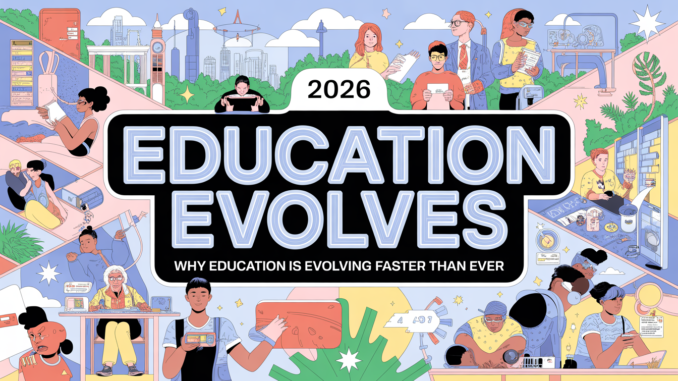
Picture this: It’s 2026, and your kid’s “school day” starts with an AI tutor asking, “Hey, did you dream about dinosaurs again last night?” No, this isn’t a sci-fi movie. This is real life in classrooms right now. Education isn’t just changing—it’s sprinting ahead like it chugged three espressos and realized the future won’t wait. Why the sudden turbo boost? Well, blame (or thank) a perfect storm of artificial intelligence exploding everywhere, post-pandemic habits sticking around, tight budgets forcing smarter solutions, and a job market that laughs at old-school degrees. In this article, we’ll unpack exactly why 2026 feels like education’s wildest year yet. Buckle up—it’s going to be fun, a little chaotic, and full of those “wait, really?” moments.
The AI Takeover: From Sci-Fi Dream to Classroom Reality
Let’s be honest. A few years ago, AI in school sounded like something out of a cartoon where robots grade papers and teachers sip coffee on the beach. Fast-forward to 2026, and AI isn’t just helping—it’s basically running the show in smart ways. Generative AI tools now create custom lesson plans in seconds, adapt to how fast (or slow) a kid learns, and even spot when a student is about to zone out during algebra.
Why so fast? Simple: the technology got ridiculously good, ridiculously quick. After the big AI boom starting around 2023, schools finally stopped treating it like a fancy toy and started using it as the main engine. Reports from places like Deloitte and the OECD show that by early 2026, AI moved from “let’s try this in one class” to “okay, every kid gets their own AI sidekick.” It’s workflow-first now—teachers use it to cut down on boring admin stuff like grading multiple-choice quizzes, freeing them up for the human stuff that actually matters.
But here’s the funny part: kids are ahead of the adults again. Surveys show student use of AI jumped to over 90% in some universities by late 2025, while half the teachers were still figuring out how to turn on the smartboard. One middle-school teacher I chatted with joked, “My students ask ChatGPT for homework help before they ask me for a bathroom pass.” The humor hides a real shift—AI makes learning feel personal instead of like lining up for the same bus every day.
The speed comes from two things colliding: cheaper tech and desperate need. Enrollment is dropping in many places because of the “demographic cliff” (fewer babies born years ago means fewer teens now), so schools had to get creative or risk closing doors. Budgets are tight too, with funding cuts hitting hard. Instead of buying more textbooks that go out of date faster than milk, districts invested in platforms that update themselves.
Here’s a quick comparison to show how wild the jump has been:
| Old-School Setup (Pre-2020) | 2026 Classroom Vibes |
|---|---|
| One teacher lectures to 30 kids at the same pace | AI adapts lessons in real time for each student |
| Textbooks printed on paper that weigh a ton | Interactive digital modules that change based on your answers |
| Field trips cost a fortune and happen once a year | VR trips to Mars or the bottom of the ocean for free |
| Teacher burnout from grading 100 essays | AI handles first drafts; teachers focus on feedback and encouragement |
Personalized Learning: No More One-Size-Fits-All
This is the biggest “why” behind the evolution. For decades, education treated every kid like they learned the exact same way at the exact same speed. Spoiler: they don’t. In 2026, personalized learning isn’t a buzzword anymore—it’s the default. AI analyzes everything from quiz scores to how long a student stares at a screen (without being creepy, promise) and tweaks the next lesson on the fly.
Why the rush? The job market changed overnight. Employers want “power skills” like creativity, emotional intelligence, and adaptability more than memorizing dates from history class. Traditional degrees are nice, but micro-credentials—short, skill-packed certificates—are exploding because they prove you can actually do stuff. Lifelong learning became non-negotiable when AI started taking over routine jobs.
Imagine little Timmy who hates reading but loves building robots. In the old days, he’d struggle through the same novel as everyone else and feel dumb. Now his AI tutor turns the story into a robot-building quest. Funny story: one school reported a kid who improved his writing scores by 40% after the system noticed he learned best through rap battles. The teacher said, “We went from Shakespeare to hip-hop Shakespeare. The kids ate it up.”
Lists make this easier to picture. Here are the top perks of personalized learning in 2026:
- Faster progress for advanced kids – No more boredom waiting for the class to catch up.
- Extra help for those who need it – Struggling? The system loops back with easier steps instead of moving on.
- Mental health boost – Lessons feel less like a pressure cooker and more like a custom playlist.
- Data that actually helps – Teachers get reports showing what works, not just test averages.
Of course, privacy worries pop up (because nothing good comes without a side of “wait, who sees this data?”), but schools are finally adding real rules around it.
Global Access: Education Without Borders
Another rocket fuel for change? The internet finally delivered on its promise. Rural kids in Cambodia, busy parents in Phnom Penh, and urban teens in New York can all tap into the same world-class resources. Online platforms exploded after the pandemic, and in 2026 they’re smoother, cheaper, and way more inclusive.
Why faster now? Global competition and equity demands. Countries realized they can’t afford to leave anyone behind when AI economies reward the skilled. Sustainability snuck in too—green education is hot, with lessons on climate change baked into every subject. One cool trend: virtual exchange programs where students in different continents team up on projects without plane tickets.
Humor alert: My friend’s nephew in a small town used to think “international” meant the next province. Now he debates AI ethics with a kid from Brazil during lunch. The only downside? Time zones make group projects feel like a 24-hour party you didn’t sign up for.
Teachers: The New Superheroes (With Capes Made of Coffee)
Here’s where it gets emotional. Teachers aren’t being replaced—they’re being upgraded. In 2026, the role shifted from “stand at the front and talk” to “coach, mentor, and emotional support wizard.” AI handles the repetitive stuff, so teachers focus on building relationships, spotting when a kid needs a hug or a tough conversation.
Burnout was real after the pandemic, with workloads piling up like laundry. Now, tools cut planning time by half. But it’s not all sunshine—some teachers joke they went from “sage on the stage” to “AI wrangler and feelings manager.” Training programs finally caught up, teaching educators how to work alongside bots without losing their spark.
A table of the evolution:
| Teacher Role Yesterday | Teacher Role in 2026 |
|---|---|
| Deliver information | Facilitate experiences and critical thinking |
| Grade everything by hand | Use AI for first pass, add human insight |
| Handle all admin alone | Team up with tech for efficiency |
| One expert for 30 kids | Curator of personalized paths plus life coach |
Curriculum Shake-Up: Skills Over Seat Time
Curriculums in 2026 look nothing like the ones we grew up with. Forget cramming facts for a test you’ll forget by summer. Now it’s project-based, skills-focused, and tied to real-world problems. Sustainability, AI ethics, financial literacy, and mental health are front and center. Career and technical education (CTE) got a glow-up, with high schools offering apprenticeships alongside diplomas.
The “why” is obvious: the world moves too fast for static knowledge. One expert called it “learning how to learn” becoming the ultimate superpower. Microcredentials let adults upskill without quitting their jobs. Higher ed is scrambling too, with interdisciplinary degrees (think biology meets coding meets business) outpacing old majors.
Funny line: A principal told me, “We used to teach kids to memorize the periodic table. Now we teach them how to ask an AI the right question about it—and then build something cool with the answer.”
The Bumps in the Road (And the Laughs That Come With Them)
No big change happens without hiccups. Budgets are squeezed, so not every school gets the shiny new toys at once. Some parents worry kids are staring at screens too much (fair point—brain rot is a real meme). And let’s not forget the great “AI wrote my essay” panic of 2025 that carried into this year. Teachers now have tools to spot it, but the arms race is hilarious.
Equity gaps still exist. A fancy VR lab in one district versus a basic laptop in another feels unfair. Policy shifts under new administrations add another layer of “what now?” But schools are adapting with creative hacks, like sharing resources regionally.
Humor saves the day: One district’s AI system once scheduled every kid for gym at the same time—chaos ensued with 200 sneakers squeaking in one hallway. They fixed it, but the story lives in teacher group chats forever.
Real Wins: Schools Getting It Right
In places like forward-thinking districts in the US and innovative programs in Asia, the results speak loud. One high school using full AI personalization saw graduation rates jump 15% and engagement scores skyrocket. Another university rolled out microcredentials tied to local jobs, and graduates landed work faster than ever. Even in smaller towns, hybrid models kept rural schools alive.
These stories prove the evolution isn’t just hype—it works when done right.
What’s Next: The Crystal Ball (Slightly Smudged)
By late 2026 and beyond, expect even tighter integration: AI that predicts learning struggles before they happen, full immersive worlds for every subject, and education that follows you from kindergarten to retirement. The focus stays on human stuff—empathy, creativity, ethics—while tech handles the rest.

Wrapping It Up: Why This Matters to All of Us
Education in 2026 isn’t evolving faster just because tech got cooler. It’s because the world demanded it. Jobs changed, kids changed, and society finally admitted the old model was creaking like an old wooden desk. Sure, there are growing pains and plenty of “this is weird” moments (hello, robot debate club). But the payoff? Kids who love learning, teachers who don’t burn out by October, and a workforce ready for whatever curveball comes next.
If you’re a parent, teacher, or just someone who remembers school as rows of desks and boredom, take heart. The future looks messy, exciting, and way more human than the robots suggest. Grab your virtual backpack—it’s going to be one heck of a ride. And if your AI tutor ever asks about dinosaurs again? Tell it you’re ready for the next adventure.
Copyright © 2026 | WordPress Theme by MH Themes
Leave a Reply